Bir Tikendrajit University Admissions Open for Jan 2026 (Year Mode) and June 2026 (Semester Mode) Session with Late Fees of Rs. 1000. Last Date to Apply: 10 November 2026.
Online Education In India: 10 Weird Myths To Know
Published on September 17, 2026

Online education in India has become a powerful way to earn degrees, develop new skills, and advance careers without the constraints of location or traditional classroom schedules. Yet, many myths still prevent learners from understanding the opportunities and limitations of this mode of study.
As a trusted consultancy and admission center, SIILAP helps students understand online education and choose programs based on their academic goals, eligibility, and current recognition requirements.
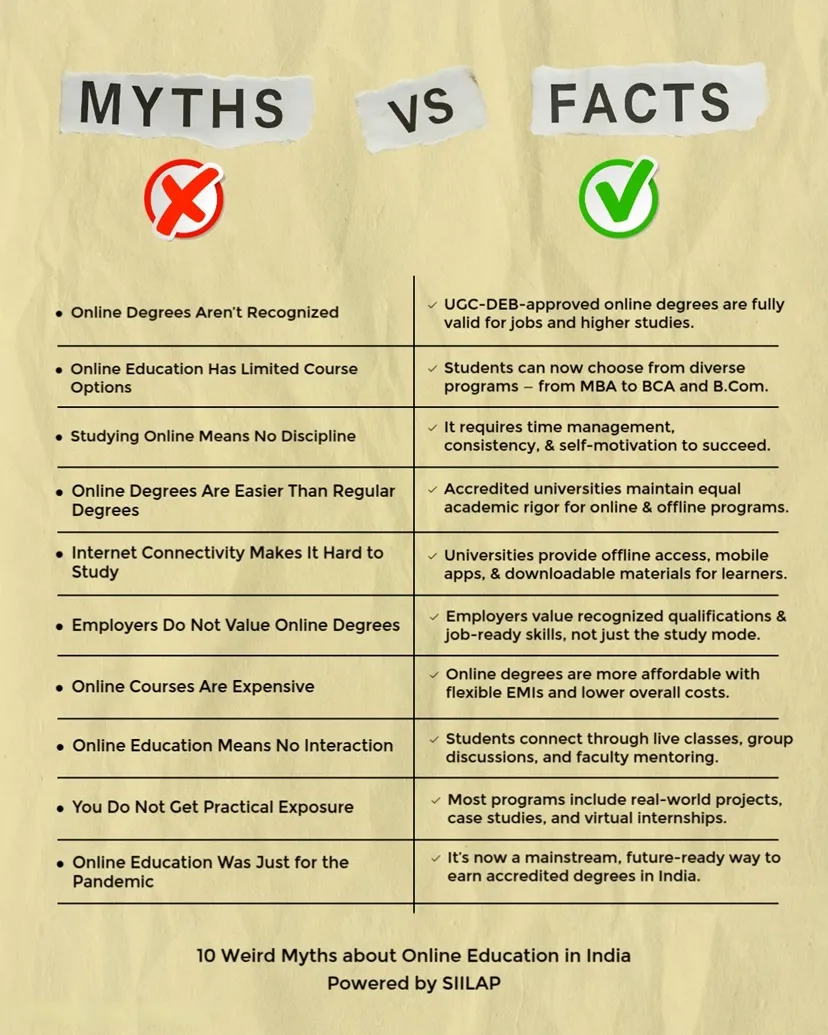
Let’s debunk 10 common myths that can create confusion about online learning.
Myth 1: Online Degrees Aren’t Recognized
Truth: Recognised online degrees are not automatically less valuable simply because they are delivered online. Under UGC regulations, undergraduate and postgraduate degrees awarded through recognised ODL or Online programmes can be treated as equivalent to corresponding conventional degrees, subject to the applicable requirements.
However, students should verify the recognition status of the university and the specific programme for the academic session in which they plan to enrol. The UGC-DEB specifically advises learners to check the recognition status of the HEI and programme before admission.
You can also read our detailed guide on Why Online Degrees Are Gaining Popularity Among Students to understand why more learners are considering online education.
Myth 2: Online Education Has Limited Course Options
Truth: Online education now covers a wide range of academic and professional fields.
Universities may offer undergraduate, postgraduate, diploma, and other eligible programmes through online or distance learning. Options can include business, management, commerce, computer applications, arts, science, and other disciplines permitted under applicable regulations.
However, not every programme can legally be offered through Online or ODL mode. Students should always check the current UGC-DEB programme list and any applicable regulatory requirements before enrolling.
Myth 3: Studying Online Means No Discipline
Truth: Online learning still requires regular academic participation and time management.
Depending on the programme and university, students may have scheduled classes, assignments, examinations, assessments, project work, and academic deadlines.
SIILAP's counselling team helps learners understand programme requirements and choose courses that fit their academic and career plans.
Myth 4: Online Degrees Are Easier Than Regular Degrees
Truth: The mode of delivery does not automatically determine the academic difficulty of a programme.
Recognised online programmes are required to follow applicable academic and regulatory standards. Students may still need to complete assignments, examinations, projects, and other academic requirements depending on the course.
Learners should therefore compare programmes based on curriculum, university recognition, academic support, assessment methods, and their own learning goals rather than assuming that online study is simply easier.
Myth 5: Internet Connectivity Makes It Hard to Study
Truth: Internet access can still be an important consideration, but digital learning resources have become increasingly accessible.
Many universities provide online study materials, recorded lectures, digital resources, and other learning support that allow students to study according to their schedules.
Students should nevertheless check the specific technical requirements of their chosen programme, especially where live classes, online assessments, or other internet-based activities are involved.
Myth 6: Employers Do Not Value Online Degrees
Truth: A recognised online degree can be used for employment and further education, subject to the eligibility requirements of the employer, institution, examination, or recruiting organisation.
UGC-DEB states that eligible undergraduate and postgraduate degrees awarded through recognised ODL or Online programmes can be treated as equivalent to corresponding conventional degrees under Regulation 22.
At the same time, students should not assume that every job or professional pathway has identical eligibility rules. Specific employers, professional regulators, or recruiting bodies may prescribe additional requirements.
Myth 7: Online Education Is Always Expensive
Truth: The cost of online education varies significantly from one university and programme to another.
Online learners may save on some expenses associated with conventional campus study, such as daily commuting or relocation. However, tuition fees, examination charges, technology requirements, and other costs can differ between programmes.
SIILAP helps students compare available programmes and understand their admission and fee requirements before making an academic decision.
Myth 8: Online Education Means No Interaction
Truth: Online learning can include several forms of academic interaction.
Depending on the university and programme, students may have access to live classes, recorded lectures, webinars, discussion forums, academic support, and interactions with faculty or fellow learners.
Students can also receive admission and administrative guidance through SIILAP's student support services.
Myth 9: You Do Not Get Practical Exposure
Truth: Practical exposure depends heavily on the programme and its curriculum.
Some eligible online programmes may include projects, case studies, assignments, simulations, virtual activities, or other forms of applied learning.
However, practical and laboratory requirements can affect whether a programme is permitted through online mode. UGC-DEB states that online programmes requiring practical or laboratory courses as a curricular requirement are not permitted, while certain professional disciplines are also prohibited in ODL and Online mode.
Students should therefore check the programme structure and current regulatory position rather than assuming that every course provides the same type of practical exposure.
Myth 10: Online Education Was Just for the Pandemic
Truth: Online education has continued to develop beyond the pandemic as part of the broader digital transformation of higher education.
The growth of digital learning platforms, online academic resources, and flexible study options has created new ways for learners to access higher education.
Market research organisations such as Statista have also projected continued growth in India's e-learning market. However, market projections can change over time and should be viewed as forecasts rather than guarantees.
SIILAP continues to guide students who want to explore online programmes while helping them understand eligibility, recognition, programme requirements, and admission procedures.
Final Thoughts: Believe Facts, Not Myths
Online education is changing the higher education landscape in India by giving learners additional ways to access education, develop skills, and pursue academic qualifications.
But choosing an online programme requires more than simply believing that online education is flexible or convenient. Students should check the university's current recognition status, the specific programme, the academic session, eligibility requirements, and any applicable regulatory restrictions before enrolling.
SIILAP helps learners understand these factors and explore suitable higher education options according to their academic and career goals.
Frequently Asked Questions (FAQs)
Q1. Are online degrees in India recognized?
Degrees awarded through online programmes recognised by UGC under the applicable regulations can be treated as equivalent to corresponding conventional degrees. Students should verify the university and specific programme's recognition status for their admission session on the UGC-DEB website.
Q2. Do online courses offer practical experience?
Some online programmes include projects, case studies, simulations, and other forms of applied learning. However, programmes requiring practical or laboratory courses may not be permitted through online mode, and some disciplines are specifically prohibited.
Q3. Is online education suitable for working professionals?
Online education can provide flexibility for working professionals because learning resources and classes may be accessible remotely. However, students should review the schedule, assessment requirements, and workload of the specific programme before enrolling.
Q4. Will poor internet connectivity stop me from learning online?
Internet access is important for online learning, but universities may provide recorded lectures, downloadable study materials, and other digital resources. Students should check the technical requirements of their chosen programme before admission.